Evaluating Happy Aniria for Modern Design Projects
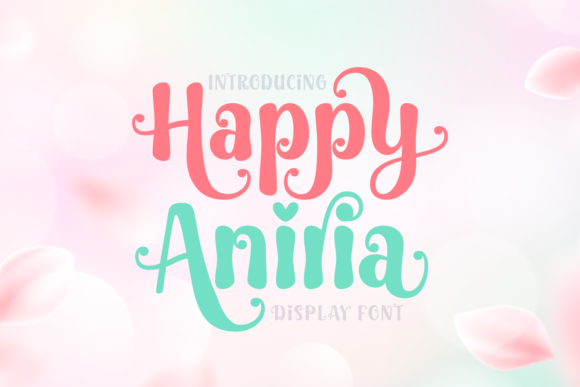
Selecting the right typeface is one of the most critical decisions in visual communication. A font does more than convey text; it establishes tone, guides readability, and reinforces brand identity. Among the growing library of digital typefaces, Happy Aniria has emerged as a notable option for designers seeking a blend of whimsy and sophistication. Described as a trendy, joyful, and stylish display font, it occupies a unique space between playful casualness and polished elegance.
This evaluation explores the characteristics, technical specifications, and practical applications of Happy Aniria. By examining its adaptability, encoding benefits, and potential limitations, designers can make informed decisions about whether this typeface aligns with their specific project requirements.
Understanding the Design Language of Happy Aniria
At its core, Happy Aniria is a display font, meaning it is optimized for use at larger sizes where legibility takes a backseat to aesthetic impact. The design philosophy behind the font emphasizes joy and style. The letterforms often feature soft curves, dynamic weights, and subtle quirks that give the text a human, approachable feel. This "joyful" quality makes it particularly effective in contexts where warmth and positivity are desired.
However, describing it solely as "fun" would be an oversimplification. Happy Aniria possesses an adaptable style that allows it to function in both formal and informal settings. In informal contexts, such as social media graphics or party invitations, its playful nature shines. In more formal designs, such as editorial headers or sophisticated branding materials, its clean lines and stylish proportions prevent it from appearing childish or unprofessional. This duality is what makes the font versatile.
Technical Advantages: PUA Encoding and Glyph Access
One of the most significant technical features of Happy Aniria is its use of Private Use Area (PUA) encoding. For designers unfamiliar with this term, PUA refers to a section of the Unicode standard reserved for custom characters. While modern OpenType fonts often rely on advanced ligatures and contextual alternates managed by software, PUA-encoded fonts store alternative glyphs directly into specific character slots.
The primary benefit of this approach is accessibility. Because all glyphs and swashes are mapped to accessible keys, users can access these decorative elements with ease. There is no need to navigate complex OpenType panels or hope that a design application supports specific contextual alternates. If a designer wants a specific swash or alternate character, they can typically type a corresponding key combination or select it from a simplified menu. This straightforward workflow reduces friction during the creative process, allowing for rapid prototyping and consistent application of decorative elements.
- Simplified Workflow: Direct access to special characters without complex software configuration.
- Visual Consistency: Ensures that swashes and alternates are applied uniformly across a document.
- Broad Compatibility: Works effectively in older design software that may not fully support advanced OpenType features.
Ideal Use Cases for Happy Aniria
Given its aesthetic and technical profile, Happy Aniria is well-suited for specific categories of design work. It excels in projects where personality is paramount.
Brand Identity and Logo Design
For startups, lifestyle brands, or creative agencies looking to project a friendly yet professional image, Happy Aniria offers a strong foundation. Its stylish nature ensures that logos remain memorable, while its adaptability prevents them from feeling too niche. It is particularly effective for brands in the wellness, lifestyle, education, or creative arts sectors.
Editorial and Marketing Materials
In marketing collateral such as brochures, flyers, and digital banners, headlines require immediate impact. Happy Aniria’s display qualities make it ideal for grabbing attention. The font’s joyful character can enhance the emotional appeal of promotional content, making products or services seem more inviting and accessible.
Event and Wedding Stationery
The "happy" aspect of the font name is not merely thematic; it reflects its suitability for celebratory events. Wedding invitations, birthday cards, and event programs often call for typography that feels personal and elegant. Happy Aniria strikes a balance between ornate and readable, making it a popular choice for stationery designers who want to avoid overly traditional serif fonts.
Considerations and Potential Tradeoffs
While Happy Aniria offers distinct advantages, it is not a universal solution. Understanding its limitations is crucial for avoiding misapplication.
Readability Constraints
As a display font, Happy Aniria is not intended for body text. Using it for long paragraphs will fatigue the reader and obscure the message. Designers must reserve it for headlines, subheads, and short pull quotes. Overuse of display fonts can also lead to a cluttered visual hierarchy, so it should be paired with neutral, highly legible sans-serif or serif fonts for supporting text.
PUA Encoding Limitations
While PUA encoding simplifies glyph access, it can pose challenges in web development and certain digital publishing workflows. Web browsers and some CMS platforms may not render PUA characters correctly if the font file is not properly embedded or if the encoding conflicts with other systems. For print-based projects, this is rarely an issue, but for responsive web design, developers should test thoroughly to ensure cross-browser compatibility.
Trend Sensitivity
The "trendy" descriptor implies that the font’s appeal may evolve with design trends. Fonts that lean heavily into current stylistic movements can sometimes feel dated as aesthetics shift. Designers should consider whether the specific look of Happy Aniria aligns with their long-term brand goals or if it serves a temporary campaign need.
Comparing Alternatives
When evaluating Happy Aniria, it is helpful to consider alternatives based on specific needs.
- For Strictly Formal Projects: If the goal is serious corporate communication, a classic serif or geometric sans-serif may be more appropriate. Happy Aniria’s inherent playfulness might undermine the desired authority.
- For High-Volume Text: If a project requires extensive reading material, a dedicated body text font with superior legibility at small sizes is necessary. Happy Aniria should only complement, not replace, functional typefaces.
- For Web-First Designs: If the primary output is digital and relies on system fonts or variable fonts for performance, a PUA-encoded static font might introduce unnecessary file size bloat or rendering issues. In such cases, exploring variable display fonts with native OpenType support might be more efficient.
Decision-Making Insights
To determine if Happy Aniria is the right choice, designers should ask themselves three questions:
- Does the project prioritize personality over neutrality? If yes, Happy Aniria’s joyful style is a strong asset.
- Is the text primarily used at large sizes? As a display font, it performs best in headlines and titles.
- Are there technical constraints regarding font encoding? If the project involves complex web integration, verify PUA compatibility before committing.
Happy Aniria represents a thoughtful intersection of style and utility. Its PUA encoding streamlines the inclusion of decorative elements, while its adaptable aesthetic allows it to bridge the gap between casual and formal design. By understanding its strengths and limitations, designers can leverage Happy Aniria to create visually engaging and emotionally resonant communications.