Savad: Exploring the Intersection of Arabic-Persian Heritage and Modern Typography
In the vast landscape of design, typography serves as more than just a vehicle for text; it is a cultural artifact that carries historical weight, aesthetic nuance, and emotional resonance. Among the diverse array of typefaces available to designers today, Savad stands out as a distinctive choice that bridges ancient linguistic roots with contemporary visual demands. Derived from an Arabic-Persian term meaning "darkness" or "blackness," Savad offers a unique proposition for those seeking to infuse their projects with depth, mystery, and a bold typographic presence.
For professionals in graphic design, branding, and digital media, selecting the right font is often a matter of balancing legibility with stylistic intent. Savad enters this conversation not merely as another decorative typeface, but as a tool designed to command attention through its heavy, impactful forms. This article explores the characteristics of Savad, its practical applications, and how it compares to other bold display fonts in the market, helping you determine if it fits your specific design needs.
Understanding the Essence of Savad
The name itself provides the first clue to the font’s character. In Arabic and Persian contexts, the concept of darkness or blackness is often associated with power, elegance, and the unknown. Translated into typographic form, Savad embodies these qualities through thick strokes, high contrast, and a commanding visual weight. It is engineered for display purposes—meaning it is intended to be read at large sizes where every curve and angle can be appreciated.
Unlike standard sans-serif or serif fonts that prioritize neutrality and readability across long passages of text, Savad is built for impact. Its structure suggests a modern interpretation of calligraphic traditions, yet it avoids the complexity that might hinder quick recognition. Instead, it simplifies forms into strong, geometric, or organic shapes that convey authority. This makes it particularly effective in environments where immediate visual engagement is required, such as headlines, posters, album covers, and luxury brand identities.
When evaluating Savad, it is important to recognize that its strength lies in its specificity. It is not a universal workhorse font like Arial or Helvetica. Rather, it is a specialist tool, akin to a precision instrument in a toolbox. Understanding its origins and intended use case allows designers to leverage its full potential without forcing it into roles for which it was not designed.
Visual Characteristics and Design Utility
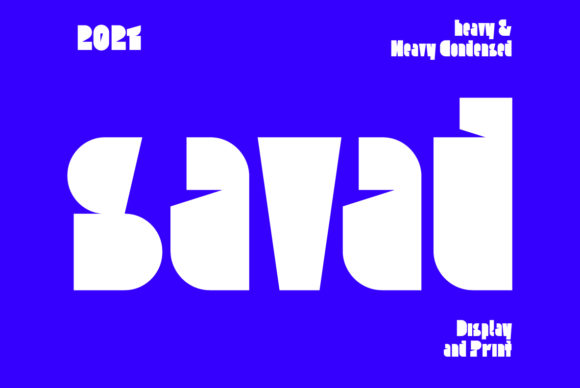
The defining feature of Savad is its thickness. The letterforms are robust, often featuring uniform or slightly varied stroke weights that create a solid block of color when set in lines. This density allows the text to stand out against busy backgrounds or compete visually with imagery. For urban-styled designs, which often rely on gritty textures, neon accents, or high-contrast photography, Savad provides a foundational element that anchors the composition.
- Bold Presence: The heavy weight ensures visibility even from a distance, making it ideal for signage and outdoor advertising.
- Cultural Resonance: The Arabic-Persian etymology adds a layer of sophistication and exoticism that can elevate a brand’s perceived value.
- Versatility in Styling: While inherently dark, Savad can be paired with lighter elements to create striking contrasts, enhancing overall layout dynamics.
However, the very traits that make Savad powerful also impose limitations. Because of its visual density, it can become difficult to read if used in small sizes or in long paragraphs. Designers must exercise restraint, using Savad sparingly to highlight key messages rather than conveying detailed information. This trade-off is common among display fonts, but it requires careful planning to ensure the final output remains accessible and engaging.
Comparing Savad to Alternative Display Fonts
When researching options for bold, impactful typography, designers often encounter several categories of alternatives. These include traditional slab serifs, modern grotesque sans-serifs, and other stylized display faces. Comparing Savad to these groups reveals distinct advantages and areas where other fonts might serve better.
Slab Serifs vs. Savad: Slab serif fonts, such as Rockwell or Courier, offer a similar sense of solidity and weight. However, they typically retain more structural detail and historical reference. Savad, by contrast, tends to strip away some of this ornamentation in favor of a cleaner, more abstract form. If a project requires a vintage or industrial feel, a slab serif might be more appropriate. If the goal is a sleek, mysterious, or culturally infused look, Savad provides a sharper edge.
Modern Sans-Serifs vs. Savad: Contemporary sans-serifs like Montserrat or Roboto are highly versatile and readable. They excel in user interface design and body copy. Savad does not compete here; it is too aggressive for general use. However, for headlines within these same projects, Savad can serve as a dynamic counterpoint to the neutral sans-serif body text. This combination creates a hierarchy that guides the reader’s eye effectively.
Stylized and Themed Fonts: There are many fonts explicitly designed to mimic calligraphy or specific cultural scripts. Some of these can appear caricatured or overly literal. Savad navigates this space by offering a subtle nod to its heritage without resorting to cliché. It feels modern and global, rather than regionally confined. This balance makes it suitable for international brands that wish to evoke a sense of depth and tradition without alienating audiences unfamiliar with the source culture.
Best-Fit Situations and Decision Factors
Determining whether Savad is the right choice depends largely on the context of the project. It shines in scenarios where atmosphere is paramount. Consider a music festival poster for an electronic or world music act; the dark, intense nature of the font aligns perfectly with the mood. Similarly, for a luxury perfume or fragrance brand, the association with "blackness" can suggest mystery, night, and exclusivity.
In digital design, Savad can be effective for landing page headers or promotional banners. Its ability to stop scrolling users in their tracks is valuable in crowded online spaces. However, accessibility must remain a priority. When using such a bold font, ensure sufficient contrast between the text and background, and provide alternative text descriptions for screen readers. The visual impact should never come at the expense of usability.
Another critical factor is pairing. Savad works best when balanced with simpler, lighter typefaces. Using it alongside other heavy or ornate fonts can result in visual clutter and confusion. A minimalist approach often yields the most professional results. Let Savad be the star, supported by understated secondary text that provides context without competing for attention.
Limitations and Practical Considerations
No single font is a panacea. Savad has clear boundaries. It is not suitable for technical documentation, legal contracts, or any content requiring precise, dense information delivery. Attempting to use it for body text will likely frustrate readers and reduce comprehension. Additionally, because it is a specialized display font, availability may vary depending on licensing agreements. Designers should verify that the version they select includes all necessary characters, especially if the project involves multilingual content.
Furthermore, the trendiness of certain typographic styles can fade. While Savad draws on timeless concepts of darkness and weight, its specific aesthetic might feel dated in a few years. To mitigate this, pair it with classic design principles and high-quality imagery. Timeless composition techniques will help extend the relevance of the typography beyond fleeting trends.
Making an Informed Choice
Ultimately, the decision to use Savad should be driven by the narrative you wish to tell. If your project demands a strong, confident, and somewhat enigmatic voice, this font offers a compelling toolkit. It allows designers to tap into rich cultural associations while maintaining a modern, clean aesthetic. By understanding its strengths, acknowledging its limitations, and comparing it thoughtfully against alternatives, you can integrate Savad into your workflow in a way that enhances rather than detracts from your creative vision.
As you explore your options, consider prototyping different layouts. Test Savad in various sizes and contexts. See how it interacts with images, colors, and whitespace. Often, the true potential of a font is revealed only through experimentation. Whether you choose Savad or another option, the goal remains the same: to communicate clearly, beautifully, and effectively. In the hands of a skilled designer, even a word meaning "darkness" can illuminate the path to a successful design.